
“Up to”, “exactly” and “at least” describe different game conditions
Published — UTC
A short qualifier can change an entire game claim. “Up to ten” gives an upper bound, “exactly ten” fixes the number and “at least ten” gives a lower bound. Dropping the qualifier during a summary can turn a possible value into a promise.
Test the wording against three counts
The rules in this table are invented language examples. They are not descriptions of an available feature.
| Wording | 8 | 10 | 12 |
|---|---|---|---|
| Positive count up to 10 | Within bound | Within bound | Outside bound |
| Exactly 10 | Fails | Passes | Fails |
| At least 10 | Fails | Passes | Passes |
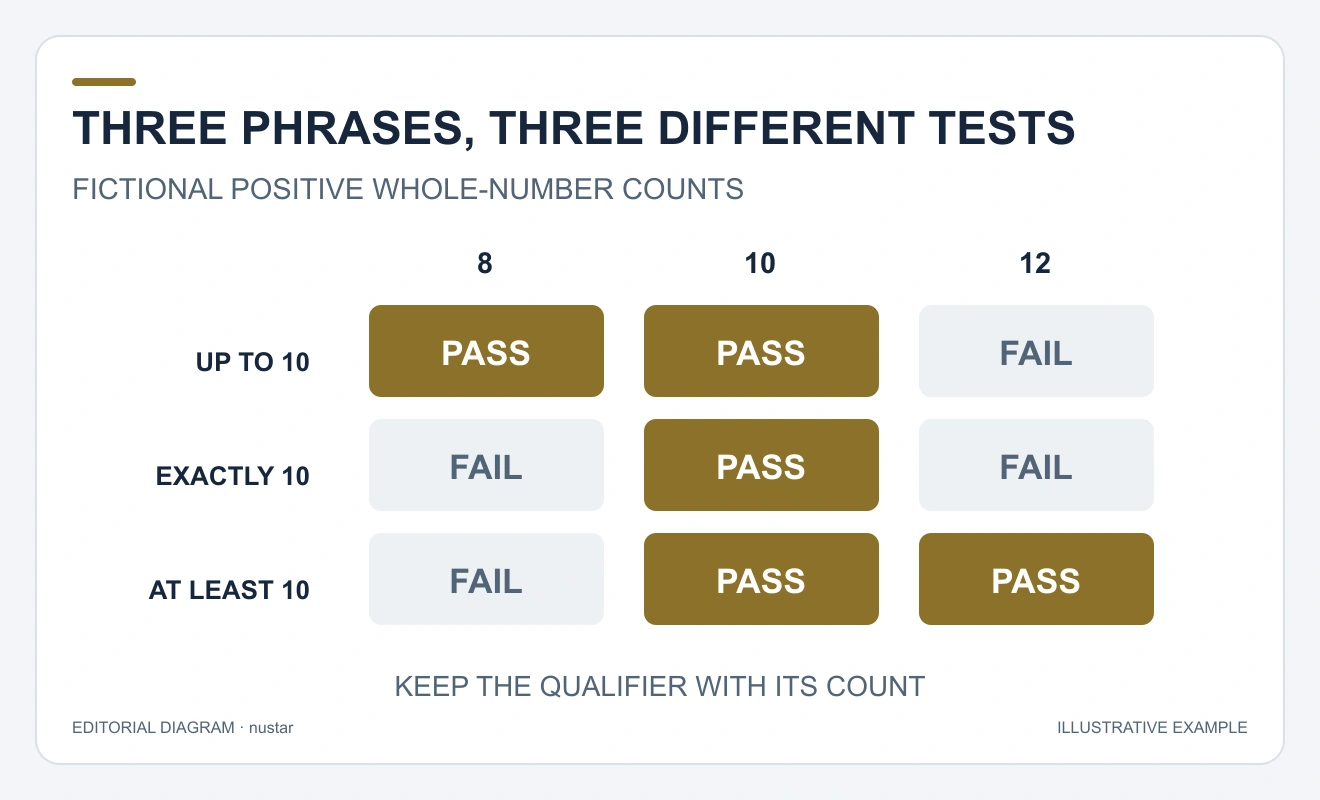
“Up to” alone also does not establish the minimum, how often the ceiling occurs or whether ten is selected automatically. The table expressly adds a positive-count assumption rather than hiding it.
Keep the qualifier beside its subject
A maximum number of awarded spins, a maximum multiplier and a maximum monetary win describe different subjects. A ten-spin ceiling cannot establish a ten-times award. Retain the whole phrase, its mode and any exception rather than copying only the headline number.
The British rules-description reference gives context for precise conditions. It does not verify an edition’s English wording or a translated product claim.
When sources disagree
Preserve both identified wordings and mark the disputed condition unresolved. Do not silently replace “up to” with “exactly” because the larger claim looks more attractive.
Check the equality sign at the boundary
For a positive whole-number count n, the three tests are 1 ≤ n ≤ 10, n = 10, and n ≥ 10. The word “positive” is why zero is excluded from the first test here. Without that added condition, “up to ten” gives a ceiling but leaves the lower bound unspecified. A decimal count of 9.5 would also fall outside this example’s whole-number field.
“More than ten” is another condition: ten fails it, while ten passes “at least ten.” Likewise, “fewer than ten” excludes ten, unlike “up to ten.” Reading only the numeral loses exactly the information needed for a boundary case.
Two qualifiers can apply at different levels
Consider the invented sentence “up to ten rounds, with at least two tokens in each eligible round.” The first condition concerns the number of rounds; the second concerns tokens within each qualifying round. It does not promise exactly twenty tokens. There might be fewer than ten rounds, and “at least two” is not a two-token ceiling.
If a separate example instead specifies exactly ten rounds and exactly two tokens per round, its total is twenty. Both exact conditions are needed for that multiplication to produce an exact total. Neither sentence establishes a token’s monetary value.
A transcription that can be checked later
Keep five fields together: the full phrase, the counted object, its unit, the mode or eligibility condition, and the rule version. Put a shortened paraphrase beside the original rather than overwriting it. For translated wording, preserve the original-language sentence so a difference such as inclusive versus exclusive can be reviewed. If an image cuts off the qualifier or footnote, the missing words stay unresolved.